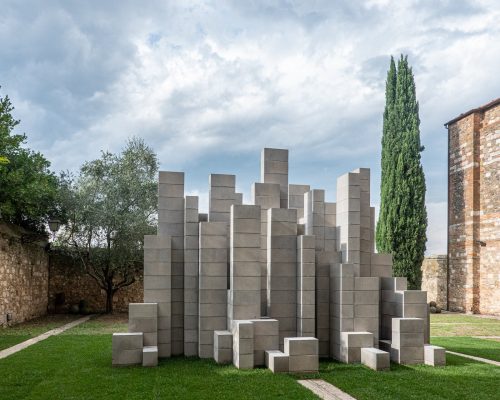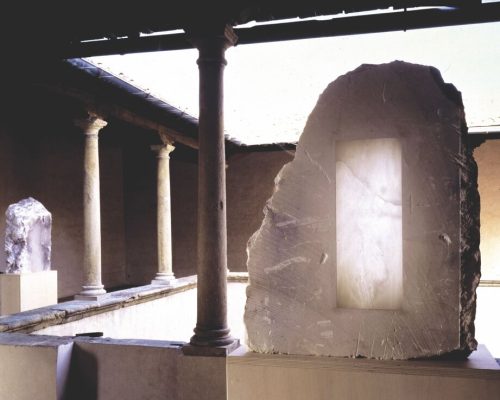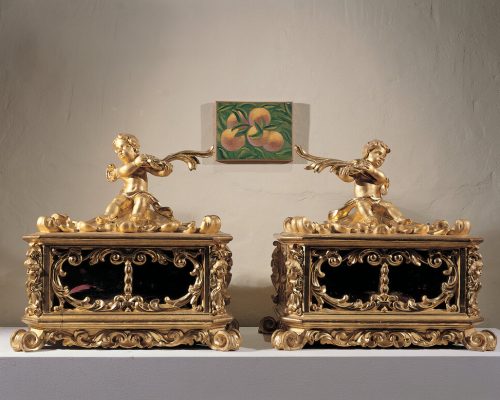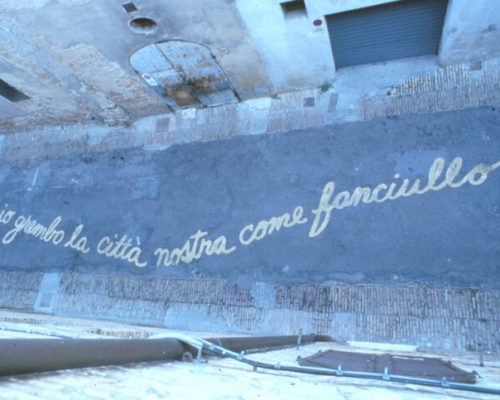
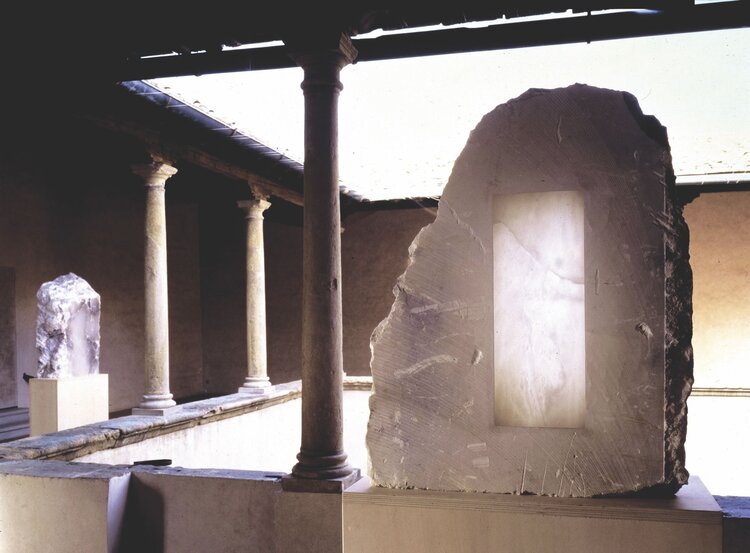
The edition You have provided an incomplete input. Please provide a complete sentence or phrase for translation. Art to Artcurated by Jan Hoet and Giacinto di Pietroantonio, took on more and more of its own characteristics, and the invited artists continued to act in their contemporary way in relation to cultures and traditions of the past. Anish Kapoor intervened with a large marble sculpture in front of the Church of San Giusto and alabaster sculptures at the Pinacoteca di Volterra. Sol LeWitt created his own installation with modular concrete blocks measuring 4 metres by 6 metres in the courtyard of the Archaeological Museum in Colle Val d'Elsa. Salvo ha proposto l’installazione dei suoi lavori nella Pinacoteca Civica di Casole d'Elsa, while Gilberto Zorio ha costruito il suo intervento coadiuvato da un maestro vetraio che ha soffiato sul posto gli oggetti che l’artista ha poi installato nella possente Fortezza di Montalcino. A San Gimignano, Marco Cingolani placed lead glazing on some views of the city; Jessica Diamond brought the colour of shadows to Via Berignano and Piazza delle Erbe; Amedeo Martegani in the garden of the fortress gave voice to the voices of the well.
This edition was also a bridge to the Piedmont region, which, thanks to the Circolo Palazzo Giovine in Alba, stretched as far as Sunrise e Baroloamong the scents and smells of the Langhe. The special setting saw David Tremlett create their own work expressly for the Castello di Falletti di Barolo and Piero Gilardi a work divided between the Church of San Domenico and the Social Theatre in Alba.
Edited by Jan Hoet and Giacinto Di Pietrantonio
“Our membership stems from the conviction that Tuscany’s polycentric nature, and its capacity to be a Tuscany of Tuscans where the relationship between tradition and contemporaneity, between landscape and human impact, between nature and culture, has a great need to find new and stimulating connections, and while being a value in itself, it finds, especially on occasions such as Art to Art, the true root for re-establishing itself as a driving and updating element of our cultural tradition.”
But to enter this exhibition more specifically Art to Art, penso che essa non voglia parlare solo dell’arte che guarda l’arte o perlomeno io non vi vedo solo questo, ma il fatto che l’arte contemporanea deve essere mostrata anche in posti differenti dal museo d’arte contemporanea che è un luogo separato.
C’è anche l’idea che tutta l’arte è contemporanea e che quando essa si manifesta non ha tempo storico. Difatti l’arte che guarda l’arte si realizza in ogni opera, anche in quella che apparentemente la esclude. In questo l’urinatoio di Duchamp è un buon esempio, perché chiamando quest’opera “Fontana” egli la pensava e la metteva in relazione, anche se in modo ironico, con tutte le altre fontane, da quella di Trevi a quelle di Versailles, e allo stesso tempo non sfugge il rapporto con La donna al bagno di Ingres.
Ma per far questo metteva un oggetto banale in un museo o in una galleria ed è per ciò che dico che Arte all’Arte va vista anche e soprattutto come metodo di esposizione, cioè esporre l’arte contemporanea in luoghi caratterizzati dall’arte del passato, questo passato che oggi ritorna. Infatti, è cosa diversa mostrare un’opera d’arte contemporanea tra le pareti bianche della galleria che in un museo archeologico Sol LeWitt, in una pinacoteca d’arte antica Salvo, in una chiesa barocca Kapoor, in una rocca medievale Zorio come in questa occasione.
Giacinto di Pietroantonio, from Arte All'Arte II, 1997