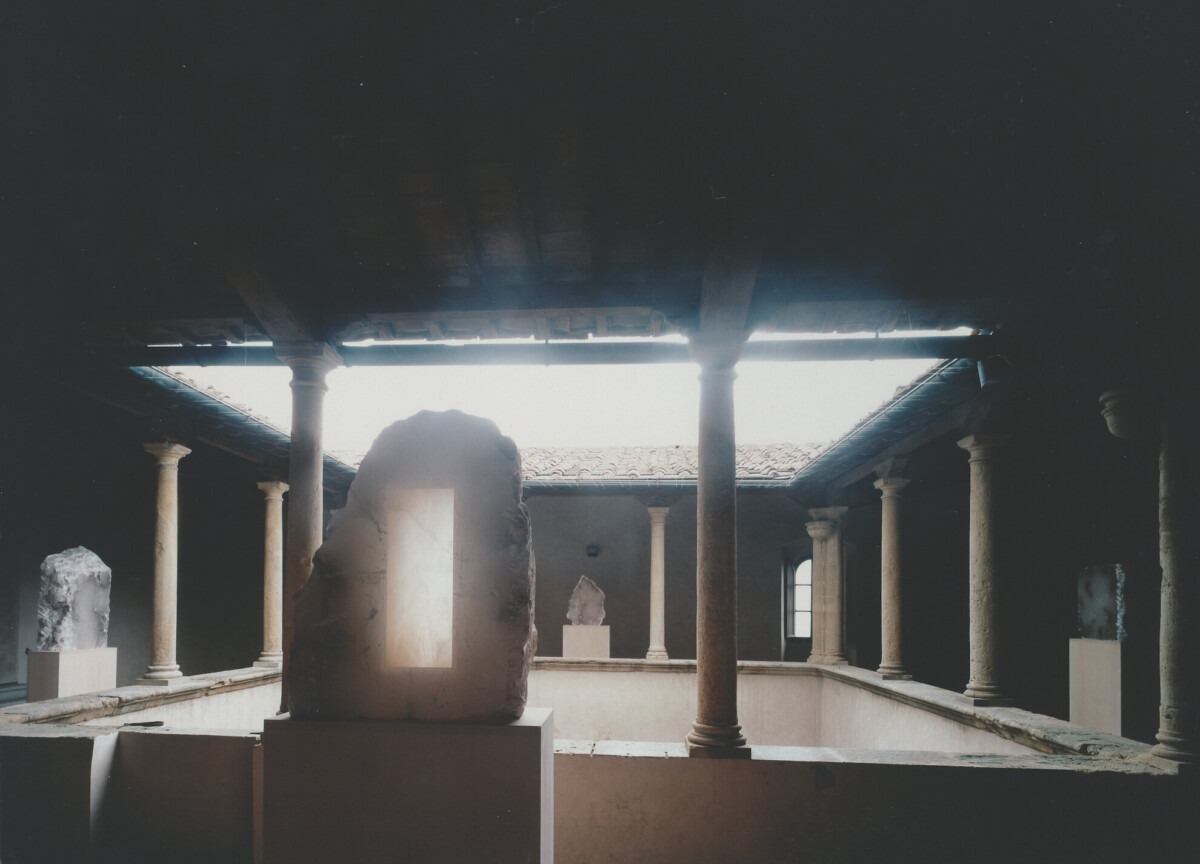
The city of Volterra hosted a series of works by Anish Kapoor created for the second edition of Art to Art curated by Jan Hoet and Giacinto di Pietroantonio.
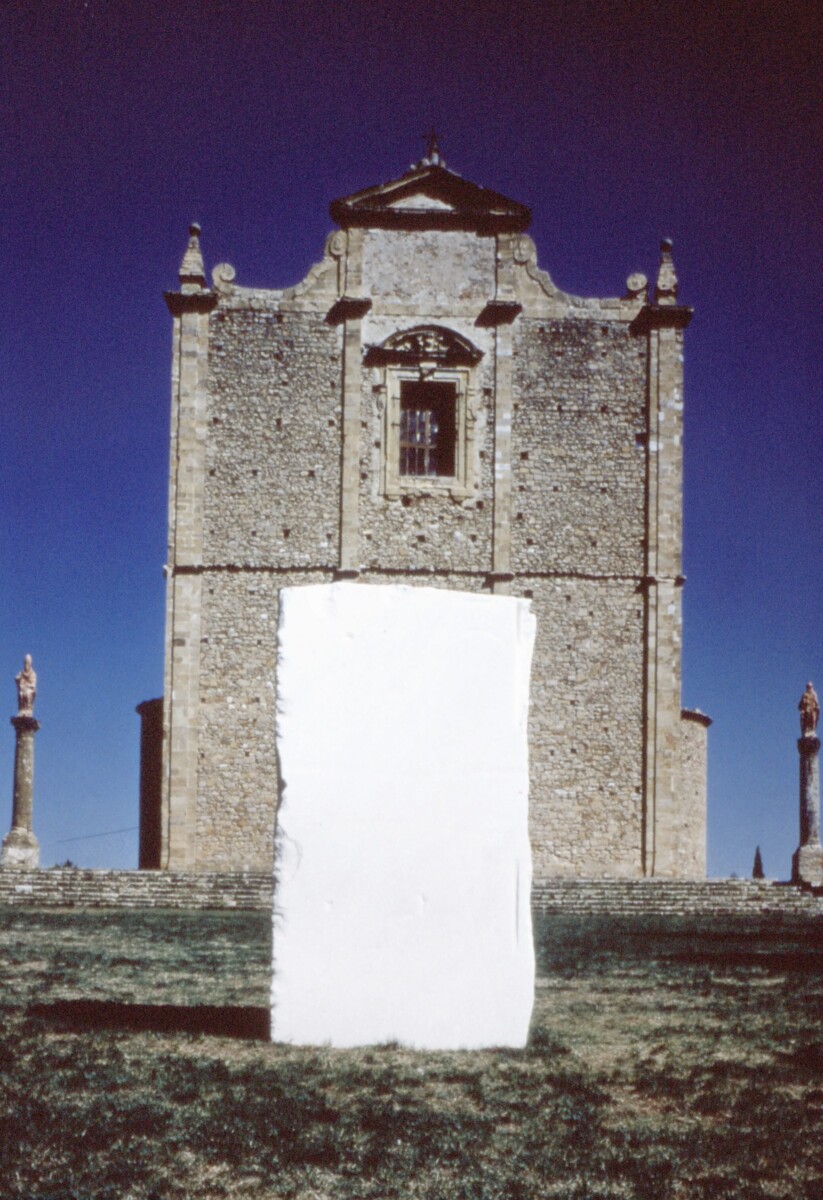
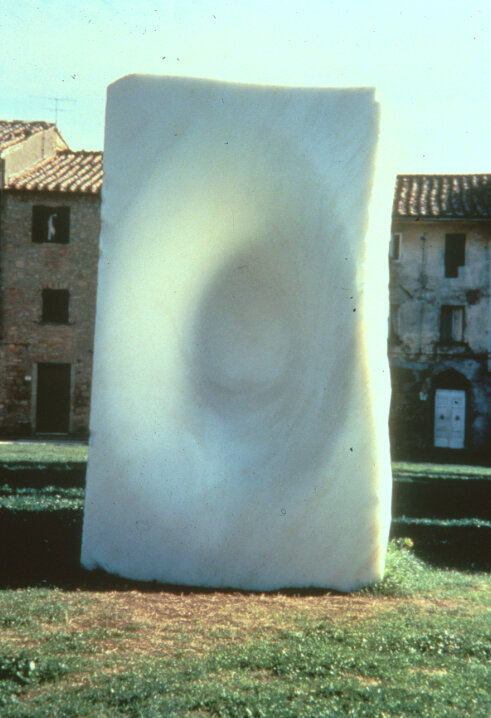
But darkness is counterbalanced by light, just as the non-color black has its opposite in white, the sum of all colors. And it is towards this luminous totality that Kapoor's research has moved in recent years with white parallelepiped-like works that once again seem to want to dissolve form into light. This light is the meaning of the work placed in front of the church of San Bartolo in Volterra. Here there is a large block of white marble, where only the side facing the church facade is worked, while the others are left rough, showing the material in transformation, in energetic potential. The facade of the work, on the other hand, appears smooth and full from a distance, but as we approach it, we realize that it is polished, hollowed out to form a convexity that draws us inward. Thus, it is as if the stone breathes, creating an internal passage, a void, which is no longer a black hole and no longer needs to be a colored cavity, because now it is a luminous surface that captures us within it, imprisoning us body and soul, also giving us the real sensation of what Michelangelo meant when he said that "Sculpture is made by taking away and painting by adding." Indeed, the crucial point of Kapoor's work lies precisely where the vision shifts from the full image of the block to that of the void, at that moment when the white and flat, thus pictorial, surface becomes sculpture and vice versa. This is how Kapoor, the painter who expresses himself through sculpture and, commenting on Michelangelo, shows us the illusory essence of appearance and the profound light of being, and in this relationship, we can say that art returns to art and that for this reason it is all eternally contemporary.
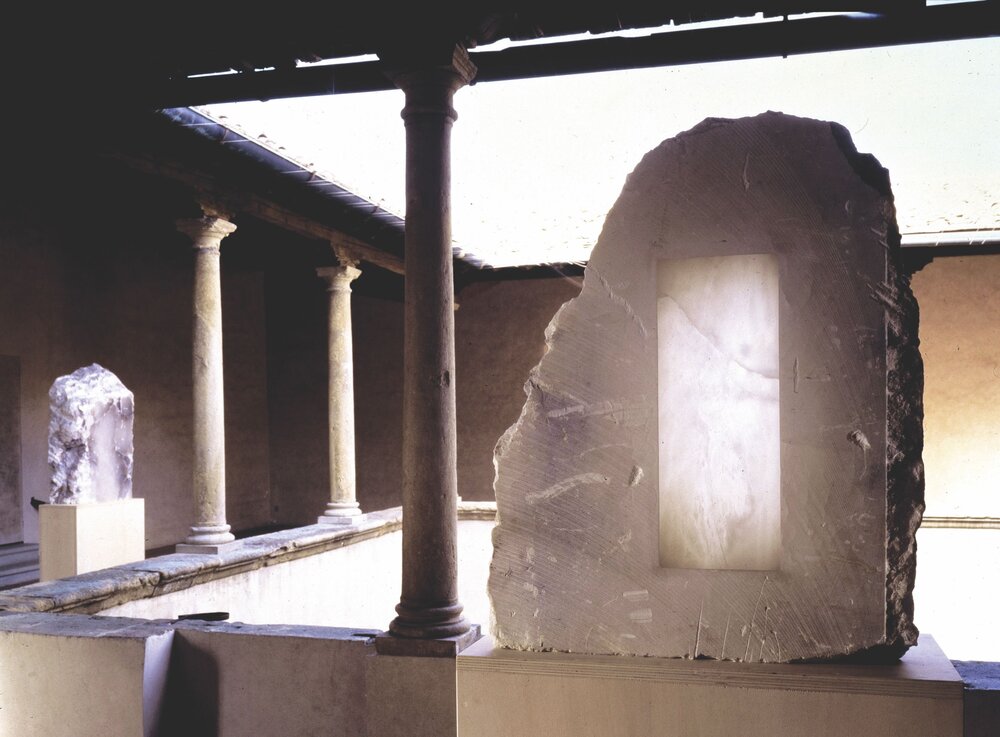
Returning to art with images of being, our unknown and unknowable being to which humanity seeks to give meaning in all its religious, philosophical, and scientific manifestations with the eternal questions: Who are we? Where do we come from? Where are we going? And which the artist, by blending knowledge and experience, shows us as the pneuma of matter, the breath of the world. Then, we could say that Kapoor's “stones” are also a kind of alchemical attempt, a new way to search for the philosopher's stone, which is not for making gold, but something much more precious like the form and spirit of being, of art, and of life. This is also visible in the four alabaster sculptures created in Volterra and placed in the city's Pinacoteca, where the work is simultaneously full, empty, heavy, light, luminous, and golden. Here, thanks to the translucent properties of the material, the artist manages to strengthen the sense of transition from painting to sculpture and from painting to its aerial dissolution until it becomes light, completing the entire cycle, because if form belongs to sculpture, light belongs to painting. Here is the light of matter, golden light like that of the philosopher's stone, which captures the state of transition as a unification of appearing and being, like the sunset that begins to close the day, or the dawn that opens to a new day. And here lies the answer for those who question the meaning of painting, sculpture, the artist, and art, because it is understood that the duality of Kapoor's work is actually a creative circularity, like the naturalness of the seasons, the movement of the planets and the cosmos, acting between the individual and the collective, and therefore ultimately becoming, like nature, an art that creates worlds.
Jan Hoet, Arte all'Arte II, 1997