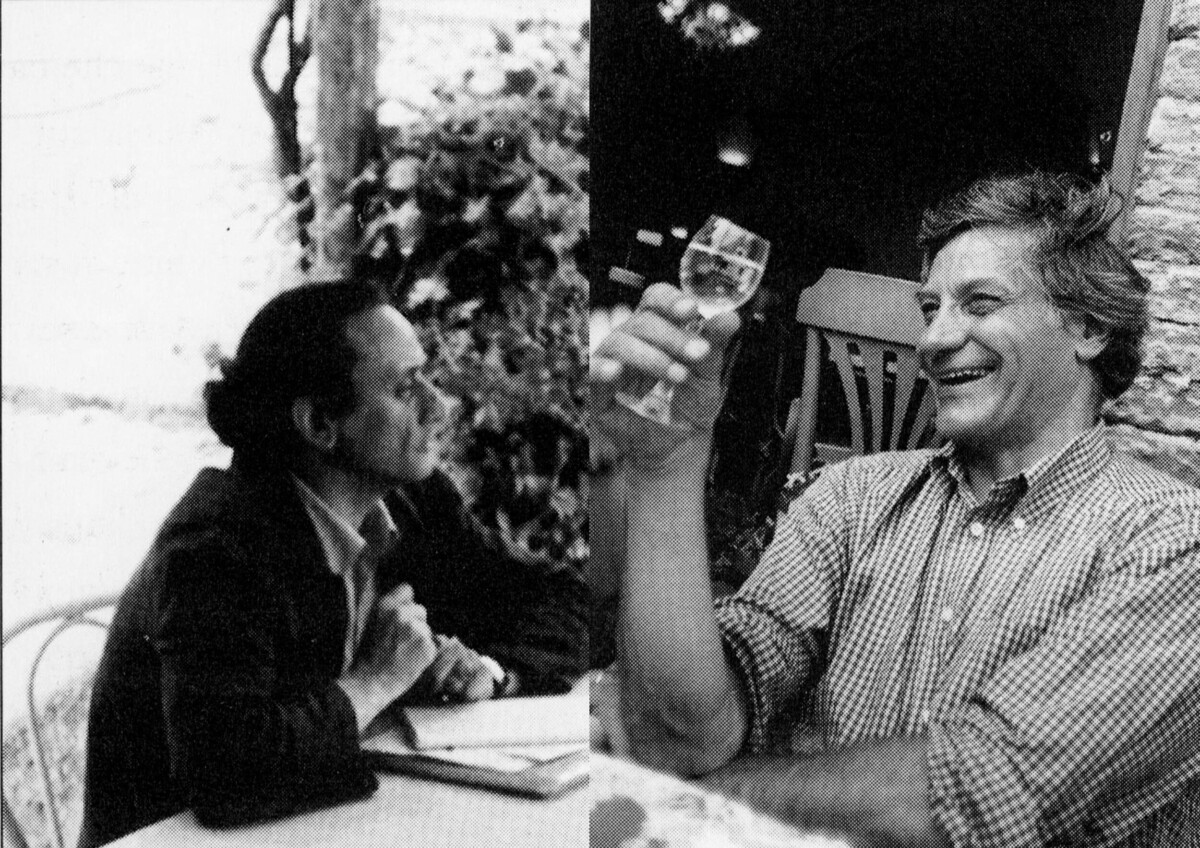
A conversation between Joan Hoet and Giacinto di Pietrantonio
Jan HoetThroughout the history of art, we find examples of artists who work tautologically on art, reflecting on how to import the past into the present. Picasso did this with Velázquez's “Las Meninas,” with El Greco, with Iberian art, with African art; he embraced the entire history of art and imported it into his era with his style. So, I ask myself if there isn't also a contradiction in this attempt to see art as autonomous. I don't think this is possible, and that it's a paradox.
Giacinto di PietroantonioReflecting the past in the present has become the norm today. The postmodern era, in fact, is characterised by this retrospective gaze in all directions and across all disciplines.
J.H.: Anche nella moda, se prendiamo a esempio, l’evoluzione di stilisti come Paco Rabanne, Armani, Versace, vediamo che questi prendono qualcosa del passato e le mettono in un colore differente, in una forma di celebrazione. Una celebrazione personale e storica, e ognuno ha il suo proprio interesse: c’è l’epoca dell’espressionismo tedesco, del cubismo, dell’arte primitiva, all’epoca di Van Gogh c’era un interesse per l’Asia…
Gross Domestic Product.Yes, during the Impressionist period, especially for Japan.
J.H.What the Impressionists did was to materialise the Japanese, to make them concrete; what was a reproduction becomes a real experience of painting. So, I understand when Picasso says: “Black art? I know nothing about it.” This is what I call the paradox. And this is true, because it is not Black art, but Picasso, whereas in the postmodern era it is rather the past that we see.
Gross Domestic Product.: L’epoca postmoderna è un’epoca…
J.H.Of fragmentation.
Gross Domestic Product.Yes, but also and above all, of information and communication, whereas in modernity it was a time of experimentation. Today we have moved from an aesthetic of experimentation to an aesthetic of communication. This is why artists use signs we already know, an alphabet we understand, not to copy the past, but rather to rewrite other stories, to speak with it about other feelings, to spread different energies. In fact, de Chirico's dialogue with the past, especially during his metaphysical period, is monolithic; characters and spaces do not allow for fragmentation; on the contrary, they are absolute, “original,” as the artist called them, just as modernity is absolute with its desire to reach the original structures of being. However, precisely because we no longer know or experience this originality, we have found ourselves unable to understand and accept it. This difficulty, expressed in de Chirico's works, shows the impossibility or refusal to communicate in a way no different from that of other seemingly different contemporary artists, but similar in their experimental intentions, such as Malevich and Duchamp. Indeed, I believe there is no difference between the refusal to speak concerning de Chirico's “The Disquieting Muses,” Malevich's “Black Square,” and Duchamp's “Bicycle Wheel.” This is the paradox of modernity, which wanted to enter life with a new language that was being constructed, experimented with, a language that appeared incomprehensible but needed a period of maturation to be learned. Today, we not only have knowledge of modernity, but we experience it on a mass level, precisely because, by merging with pre-modern languages, it has given rise to a sort of Esperanto that speaks, that communicates with everyone.
J.H.There is a reworking of history as a strategy and tactic for survival.
Gross Domestic Product.: But also a shift from a priestly attitude to a more secular one. Today, the artist no longer sees himself as a magician, a sorcerer, a scientist, or a dispenser of absolute truths; or rather, he cannot adopt a colonialist attitude. When Picasso says he knows nothing of African art, he reveals the sensibility of the era in which he lived, a still-colonial period that believed in Western absolutism. Today, and for quite some time now, this is no longer possible, just as it is no longer possible to seek authenticity through journeys to distant and exotic lands, because it is the very concept of distance, of the exotic, as well as of the ‘original’, that is being called into question. Following the collapse of the East and the spread of the East and the Global South into the West, everything has taken on a hybrid form; nothing is original anymore, precisely because so many origins have intermingled. Earlier you said that Picasso reworks the past in his own style, but for today’s artists this no longer makes sense, because they have no problem reworking the past, the present and the future using their own style and that of others. This has meant that reality has shifted from the experimental language of colonial modernity to the communicative language of postmodernity. We could say that the artists of our time stand to those of the modern period as a scientist stands to the machines produced by his studies. Indeed, his research, calculations and formulas are incomprehensible to most, whilst society makes use of tools derived from these studies. Thus, the difference between yesterday and today, between Duchamp and Warhol, for example, is akin to that between Marconi and the television, where the former’s research also led to the creation of the latter: but can we say that one is less important than the other? Andy Warhol understood and expressed this clearly when he said he wanted to be a machine, because he was very aware of this transition from the world of experimental creation to that of communicational creation. In fact, postmodernism has many detractors, because they view this surface, this turn-of-the-century veneer, with superficiality, failing to understand that if you’ve been given a computer, you must learn to use it even if you criticise it. Indeed, today artists produce works—paintings, sculptures, installations, and so on—that are immediately recognisable and, I would say, communicable, whether they draw on the twentieth century or look to Arte Povera. This is what Salvo’s works speak of: a historical stratification, where the apparent simplicity of his painting conceals the complexity of the history and experience of a conceptually refined vision; it is a sort of truth machine, a trap for fools who believe that the surface is mere superficiality.
J.H.And they are also objects of survival. We take the connotations of art to place them, through communication, in a world that feels insecure. On the other hand, artists try to do something that corresponds with what is done outside of art and at the same time refers to art, because the insecurity is so great that one cannot be without art, just as philosophers cannot be without philosophy, just as one cannot be without communication with others. In the era of modernity there was, for example in medicine, autonomous experimentation, but without communication, whereas today every experiment must be communicated to be safe.
Gross Domestic Product.: Potremmo dire che oggi, alla fine di un secolo e di un millennio, siamo in un angolo tra ricerca di sicurezza nel passato e condizione di panico esistenziale del presente, ma anche nel riniziare, per uscire dalla crisi, a guardare verso il futuro, perché a seconda di dove si decide di stare nei confronti dell’angolo storico-sociale noi possiamo agire nella vita. Se siamo solo al suo interno siamo nell’impossibilità di muoverci, ma se ci mettiamo all’esterno, ci troviamo con la punta rivolta in avanti, propositivamente verso il nuovo millennio. Ed è proprio questa ambivalenza che genera il desiderio di comunicare alla ricerca del consenso nel momento in cui la società si trova in un angolo…
J.H.To be loved, because the artist is an asocial human being, but one who needs to be loved. Therefore, they use psychological codes for this purpose.
Gross Domestic Product.But to go into more specific detail about this “Art in Art” exhibition, I don't think it only wants to talk about art looking at art, or at least I don't see only that. Rather, contemporary art needs to be shown in places other than contemporary art museums, which are separate entities. There's also the idea that all art is contemporary, and when it manifests, it has no historical time. In fact, art that looks at art is realised in every artwork, even in those which seemingly exclude it. Duchamp's urinal is a good example of this, because by calling this work “Fountain”, he conceived of it and related it, albeit ironically, to all other fountains, from the Trevi Fountain to those in Versailles, and at the same time, the connection to Ingres“ ”The Bather“ is undeniable. But to achieve this, he placed a banal object in a museum or gallery, which is why I say that ”Art in Art” should be seen primarily as a method of exhibition: that is, exhibiting contemporary art in places characterised by past art, a past that returns today. In fact, it's a different matter to show a contemporary artwork within the white walls of a gallery compared to an archaeological museum (Sol LeWitt), an old art gallery (Salvo), a Baroque church (Kapoor), a medieval fortress (Zorio), as is the case here. In 1986, with ”Chambres d'amis“, you already tried to do this in Ghent. I, for my part, attempted it in 1993 with ”Territorio Italiano“, an operation that is still ongoing today: installing contemporary works in the territory. Perhaps it's no coincidence that the first work to be installed in September 1993 was by Sozo Shimamoto on the Salvucci towers in San Gimignano, thanks to the contribution of Galleria Continua, which today promotes ”Art in Art".
J.H.Yes, but at the same time there's a challenge with history, how contemporary art relates to history without getting lost and on the other hand it has something current that needs to find harmony. Then there's this relationship with the place, with the site that was inaugurated by Arte Povera artists, a specifically Italian artistic approach.
Gross Domestic Product.Certainly, but by doing this they also relate to life and not just to art history. Think of Zorio with his sculptures that use energetic elements, movements, chemical reactions, a complex whole that makes one think of primordial worlds, of a very distant past that goes beyond history, speaking of the vital energy that flows in us and in our environment for centuries.
J.H.From prehistory, while Jessica Diamond is working with shadows, because in San Gimignano the towers are so strong that they cast very long shadows, there the artist's shadows are in marble and refer to de Chirico.
Gross Domestic Product.: Un altro segno di relazione con il passato…
J.H.Indeed, it is no coincidence that de Chirico did his work in Italy, a country where light and shadows are so strong and defined.
Gross Domestic Product.But returning to the exhibition mode is not just a return to art
J.H.: Assolutamente, perché Merz dice che: “Quando in una casa faccio un tavolo, il tavolo deve diventare una scultura e la scultura un tavolo”, dunque c’è l’ambivalenza e l’ambiguità della scelta. D’altra parte non si può negare il valore del contesto. Ad esempio, quando si fa o si colloca un’opera in un contesto non neutrale come il museo, ma in un un luogo così forte e caratterizzato come San Gimignano l’artista deve trovare la chiave giusta per un’opera fortemente ambigua che lo faccia risaltare che non è imitazione, ma mimesi, perché se dipingi un’ombra non è niente, è meglio quella vera. Allora l’ombra deve trovare una sua autonomia anche quando è inserita nel contesto sociale e non isolata come in un museo. Cingolani che istaura un dialogo con il sacro delle chiese, realizzando alcune vetrate per delle case, in cui i gesti, e le smorfie delle figure insieme alla loro dislocazione in giro per la città, rappresentano una risoluzione del paesaggio urbano italiano di sempre, in cui sacro e profano mischiandosi e scambiandosi di posto generano un contesto “spostato ed impreveibile”.
Gross Domestic Product.Kapoor also chose a church in Volterra for his work; here, there is a large block of white marble where only the side facing the façade of San Giusto is polished, while the others are left rough, showing the material transforming into energy, like a spirit before entering the church, even though I know well that Kapoor does not like to talk about animistic aspects of his art.
J.H.Yes, but it must also be understood in its paradox. And the same goes for Kaprow, whom we met today here in Como at the Ratti Foundation, who laughs when we say that art can change the world, but I'm sure it can do so on the condition that we open ourselves to art. But he laughs and jokes at these statements, says no, but I'm sure he wishes it were so, just as Kapoor inwardly feels the strong magic that his works unleash.
Gross Domestic Product.Sol LeWitt will make a sculpture of modular elements similar to the work presented at the Venice Biennale.
J.H.It is a structure made with modern calculation.
Gross Domestic Product.But can we also see an element of relation with the Gothic, the work of Venice was very reminiscent of an archetypal Gothic church in its structure. Moreover, the richness of mathematical calculation and proportional relationships underlying Gothic architecture, as well as architecture in general, which is a discipline with which Sol LeWitt has a continuous relationship and dialogue, has been demonstrated.
J.H.Yes, that's right, and you can also see how an American works differently in Europe.
Gross Domestic Product.But for him, it's something that's been happening for a while, because, having lived in Spoleto for many months of the year, you can see how he's absorbed Italian art. If we look at his wall paintings, we see that the way he treats and the type of colours are reminiscent of those of Umbrian medieval frescoes, establishing a connection with Giotto, an observation that has, moreover, already been made.
J.H.Indeed, before it was just rationality and deduction, now, since he also lives in Europe, you can see there's more warmth in his work. He works with light, with shapes we know from art history: the pyramid, for example.
Gross Domestic Product.that was added to the aesthetics of the machine, of modernist seriality.
J.H.However, it must be added that the absence of a system for contemporary art and the strong historical sedimentation have given the Italians an advantage, which led them to have to use the places they could have and which are accidental places.
Gross Domestic Product.Indeed, Martegani is creating a guide with restaurants, tourist attractions, and alternative routes.
J.H.Yes, a topology.
Gross Domestic Product.A topology, which is an Italian way of experiencing art, but above all of living and showcasing places in life that at the same time end up being places of art, given the high artistic and territorial sedimentation present in Italy. Here, Duchamp's gesture would have been impossible, because reality itself is aesthetically characterised; one could say that everything is contextualised in a place of art.
J.H.And that's why in Italy it's difficult to have a theatrical literature, with the exception of a few like Pirandello, because theatre is in life and it's difficult to compete with it.
Gross Domestic Product.More generally, it can be said that we live, not just in Italy, in a reality where the aesthetic dimension is very high, but while in Italy it relates to past art in relation to the territory, architecture and landscape, 20th-century art has spread globally more in behaviour and fashion. I am referring, for example, to Futurist music, now absorbed into pop-rock, or think of the presence of Expressionism and the Informal in Antonioni's cinema, and that of Pop in Tarantino and, through them, to the masses. This need to engage with reality seems very strong in these years, a desire that has led many artists, critics and gallerists to leave the established art world. What does all this mean? It means that finding ourselves in a postmodern and post-industrial phase also means that we have entered a post-museum era. Indeed, modernity, industrialism and the museum were born in the same era as expressions of the new social class called the bourgeoisie, which expressed, through collecting, the idea of possession and accumulation typical of capital. Today, its crisis, which had its final flourish in the 1980s in its inability not only to provide guiding values but also to control economic flows, means that the art system as established in the 1980s is no longer sufficient for art. Art needs to detach itself from the system and return to art, and therefore to the reality of life.
From the Arte all’Arte II catalogue, 1997
From the Arte all’Arte X catalogue, 2005
Grazie ai ragazzi e alle ragazze dell’Associazione Arte Continua conosciuti grazie al comune amico scomparso Luciano Pistoi, grazie perché ancor prima di ideare e promuovere Arte all’Arte mi diedero modo di realizzare la prima opera di Territorio Itliano: la collocazione degli stendardi dell’artista giapponese, appartenente al gruppo Gutaj, Shozo Shimamaoto sulle torri gemelle di San Gimignano. Ricordo: era un bel sabato di settembre, 1993. C’era anche una mostra di manifesti-opere dell’artista. A posteriori credo si trattò di un’inconsapevole prova di Arte all’Arte che doveva iniziare due anni dopo.
Coinvolto in questa avventura reale e ideale insieme a tanti altri di relazionare l’arte di ieri con quella di oggi nella credenza che l’arte è sempre contemporanea a me toccò ancora una volta prendere parte attiva come curtatore insieme a Jan Hoet nel 1996. Qui con Zorio a Montalcino, Kapoor a Volterra, Salvo a………/ Sol Lewitt a…………., Jessica Diamond, Martegani, e Cingolani a San Gimignano ci trovammo per collocare le opere all’interno e all’esterno. Tutto ciò oltre che con l’arte era sposato con la guida degli itinerari gastronomici quella volta realizzata dall’artista Martegani, invece che da un esperto di prodotti alimentari, per cui la guida era pure un’opera d’arte. Ma si sa ciò che ha fatto l’Italia è da una parte l’arte, dall’altra la cucina come insegna l’Artusi.
Ora che questa aventura compie dieci anni e deve trasformarsi in qualcosa d’altro i ragazzi e le ragazze sono già partiti per la Cina: nuova frontiera della globalizzazione. Ma intanto qui si interrompe una manifestazione divenuta punto di riferimento del viaggio dell’arte nella realtà dei luoghi artistici ed extrartistici. E’ un modo per rispondere all’idea del “withe cube”, il cubo della galleria, la stanza bianca, il luogo neutro della modernità in opposizione all’arte che si inseriva precedentemente nelle “stanze della storia” già colorate, già affescate, già decorate, già segnate. È un tentativo che cerca da una parte un’alternativa alla politica della stanza bianca, mentre dall’altra tenta di “sanare” quella cesura tra arte e vita che si è creata a partire da certa arte moderna. Va ora aggiunto che paesaggisticamente l’Italia è uno dei territori più adatti a questo tipo di sperimentazione che va dall’arte all’arte con opere belle, bellissime e sempre in corso nel laboratorio dell’arte e che, fuori e dentro il sistema, continuano a fare paesaggio.
In quest senso possiamo dire che l’Italia è un Paese-Luogo, allo stesso modo in cui l’Inghilterra è un Paese-Paesaggio, la Germania un Paese-Nero, l’America un Paese-Spazio, la Francia un Paese-Cultura, l’Olanda un Paese-Basso, il Brasile un Paese-Natura, l’India un Paese-Folla, l’Afghanistan un Paese-Duro, la Cina un Paese-Muro… Ciò vuol dire che la grande sedimentazione di luoghi “artisticamente” edificati soprattutto nel passato hanno fatto si che l’Italia nostra sia diventato un territorio in cui è l’arte a fare il luogo. Certo, viviamo in un periodo di non luoghi sia per il fatto che “l’ipermodernità” ha prodotto aereoporti, stazioni, metropolitane, centri commerciali, televisioni… luoghi che non hanno identità, in quanto di transito e transitori, e sia perché la maggior parte di essi non sono stati fatti né ad arte, né con arte. Per questo non si può negare che quando alcuni di questi sono realizzati in collaborazione con gli artisti smettono di essere dei non luoghi per diventare dei luoghi. Forse ciò è un aspetto che può costituire una delle risposte al nostro interrogativo sul senso e necessità dell’arte che qui ha trovato in questi dieci anni una realizzazione oontinua e concreta. Si fa ciò per continuare a indagare le ragioni profonde e originarie dell’arte, ma in maniera diversa per chiarire a questo punto dobbiamo riandare anche alla storia.
Quella della storia sembra essere una condanna dalla quale noi italiani non possiamo fuggire ma che, tuttavia possiamo tentare di volgere a nostro favore. Sappiamo, infatti che in Toscana tutto viene girato in direzione dell’arte per cui tutto diventa disegno o disegnato dall’arte e quindi anche il paesaggio, si parla infatti più in generale di “paesaggio toscano” e più in particolare di “paesaggio senese” addirittura i colori assumo il nome dal paesaggio con “terra di Siena”; infatti in Toscana anche il paesaggio diventa un’immagine (Lorenzetti), o la scultura assume valore di canone (Michelangelo), tutto, anche la natura qui assume il valore portato dalla cultura, la cultura dell’arte. Per cui è interessante porsi qualche altra domanda: cosa succede e perché c’è la necessità di inserire in luoghi cosi altamente caratterizzati delle opere d’arte contemporanea? Non si rischia in tal modo di produrre un cortocircuito che manda in overdose i luoghi stessi in cui avvengono questi sposalizi? Una risposta convincente la possiamo trovare nelle opere e nella relazione che le opere instaurano con i contesti nei quali vengono inserite, perché la loro collocazione non è una scelta arbitraria, in quanto gli artisti segnano con i loro lavori non un luogo a caso ma un luogo in particolare, opere pensate per questo e che contribuisce a dare forza al paesaggio e al contesto sociale, rafforzando l’idea di luogo.
Qualche parola va detta anche sulla questione del rapporto arte e società – e quindi arte e vita – e sull’ingenuità di molti artisti, curatori, ecc. per cui ciò sia risolvibile con una fotografia di una situazione di disagio nel senso che in questo caso l’artista ci mette di fronte a un’opera cosiddetta “sociale”. Non è così, in quanto sociale vuol dire un’altra cosa, per esempio che la Gioconda, pur essendo un “semplice” ritratto, è una delle opere più pubblicamente “sociali” che io conosca. Sì, perché l’arte per parlare alle persone e quindi per essere pubblica non può essere un “pannello” didattico, un semplice commento alla realtà, ma deve attivare un mistero che parla sia alla superficie che alla profondità, a ciò che anche il cristianesimo di Padre Pio e il comunismo di Marx, la leggerezza di Budda e la concretezza di Cartesio, la ciclicità dell’induismo e l’idealità di Platone, la totalità dell’ebraismo e la relatività di Einstein, addirittura la radicalità dell’islamismo e la psicanalisi di Freud e Jung non sono ancora riusciti a dare risposte. È ovvio che l’arte, qualunque essa sia, nasce ponendosi e ponendoci domande pubbliche e private, e che agisce al meglio quando non è un manifesto, una didascalia della vita, ma è nella vita stessa.
Questo è ciò che cerco nell’arte e penso che la stessa idea sia quella degli artisti con cui mi trovo a lavorare, e questo accade anche quando le apparenze sembrano contraddire questo assunto. Con ciò voglio dire e concludere che l’arte non è mai gregaria della vita e che questo tipo di esposizioni nei luoghi della vita reale stanno a imostrare in maniera ancora più evidente che l’arte torna continuamente all’arte.
Giacinto Di Pietrantonio