On the occasion of the 4th edition of Art to Art, the curators Florian Matzner and Angela Vettese invited to participate Giulio Paolini, who has chosen the Pinacoteca for his presentation Volterra.
"
Giulio Paolini chose the Pinacoteca of Volterra as the site for his intervention, where masterpieces of Italian art from the Middle Ages and Mannerism are preserved: an altarpiece by Rosso Fiorentino, in particular, in which Christ's flesh appears green like in surrealist paintings and the volumes of the figures are so geometric that they anticipate Cubism by centuries, makes the Pinacoteca a particularly fitting place to express impotence and go beyond.
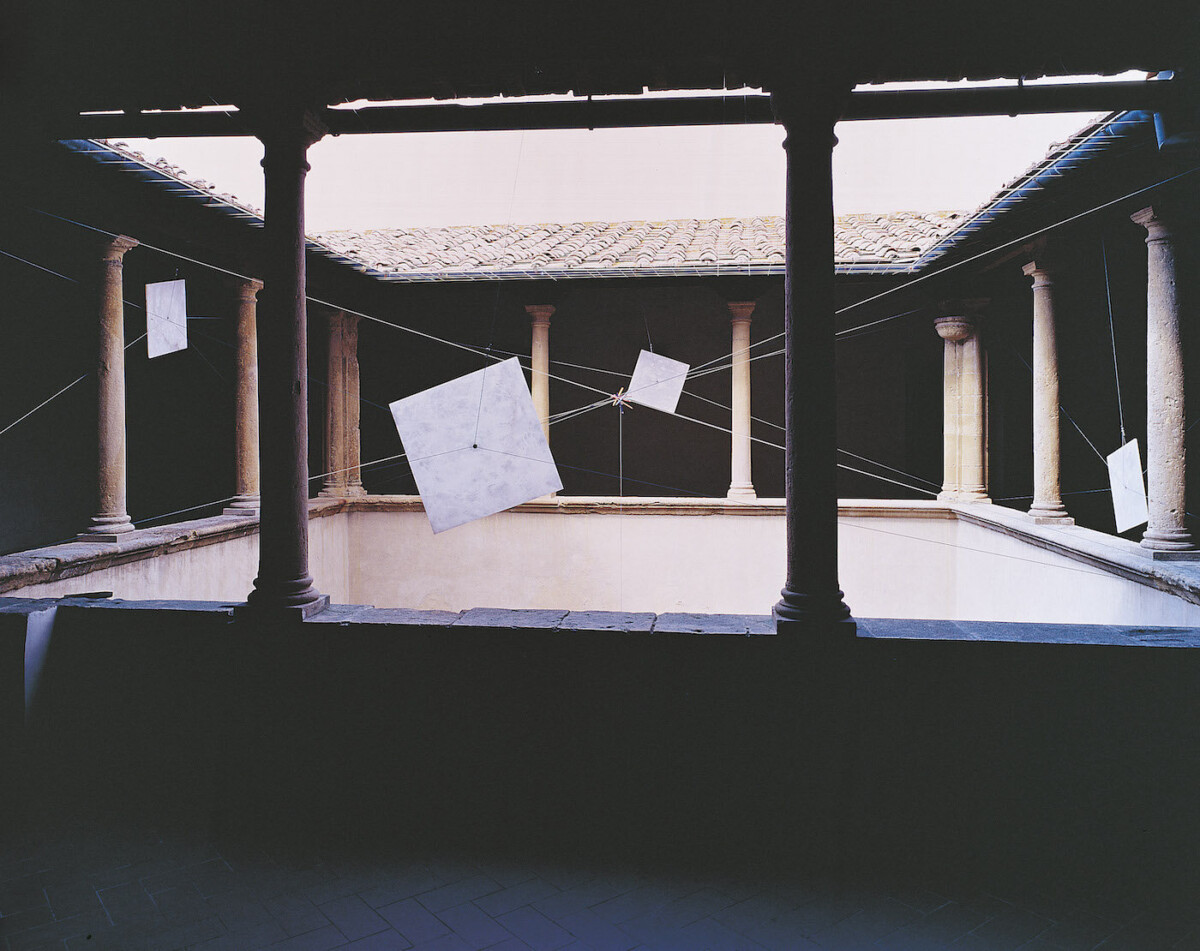
Paolini denuncia il proprio stato di afasia attraverso l’esposizione di simbolici fogli bianchi: lastre di alabastro, un materiale scelto tra quelli caratteristici di Volterra e dunque omaggio alle tradizioni locali, ma anche adatto ad essere penetrato dalla luce e dunque a essere permeabile, disponibile, in attesa di accogliere dei segni proprio come i fogli bianchi dei poeti e le tele vuote dei pittori.
Una lastra quadrata si libra al centro del cortile della pinacoteca, oscillando sul suo punto mediano, come stesse per scendere oppure si sollevasse su una base anch’essa di alabastro: un parallelepipedo purissimo e bianco che allude all’arte della scultura; anche la base vuota sembra essere in attesa di un oggetto che la sovrasti o forse, invece, orfana della scultura che reggeva.
On the third floor, in the cloister, the steel cables that support the slabs outline four vertical planes, while those that meet at the center outline a horizontal plane orthogonal to the other four. The intersection of these latter cables at the center of the cloister holds a cluster of colored pencils, as if they were arrows ready to strike the pages but not yet released. This further confirms how the five pages and the base define a void: the work is not yet completed—or perhaps can never be completed. Hence its title, Quasi. Yet at the same time, the alabaster slabs, the pencils, the base, the three-dimensional squaring of the space achieved through the wire all constitute a presence, a starting point, a sign of trust; in short, a work all the more paradoxical the more it speaks of the impossibility of making a work.
Il lavoro consiste proprio in questo, nel progettare il presente e il futuro sulla base anche fisica del passato, commentandolo e rilanciandolo in avanti, testimoniando come il singolo artista, ma anche l’uomo in generale, non sappia e non possa abbandonare il linguaggio dell’arte visiva. Piuttosto che considerarlo concluso ne continua a indagare lo scheletro o, se si preferisce, la struttura.”
Florian Matzner and Angela Vettese, Art of Art IV, 1999