Jannis Kounelliswasinvited byPier Luigi Tazzitoparticipate in the sixth edition of Art to Art. For the occasion, he created a work in Montalcino.
“Perched on its hill, Montalcino overlooks the Crete Senesi, a landscape that dazzles in every season. Jannis Kounellis contrasts this horizontal expanse, in an open dialectic, with his own vertical descent. Penetrating the surface, traversing the strata of geological time, reaching the bottom—that bottom of nigredo which the medieval alchemist regarded as the initial stage of every alchemical and salvific process.”
From there, then, to emerge to the surface, to bring up from that depths—passing through the layers of history, this time not only geological but also political, ideological, and cultural—the substance of human hope in knowledge and action, like magma pouring forth from the vent of an active volcano. As on other occasions in Kounellis’s work, the aim is to give voice to silence—which is, first and foremost, the silence of history—and the voice thus takes on an excessive tone. The silence that was once imposed, once transformed into voice, provokes an excess.
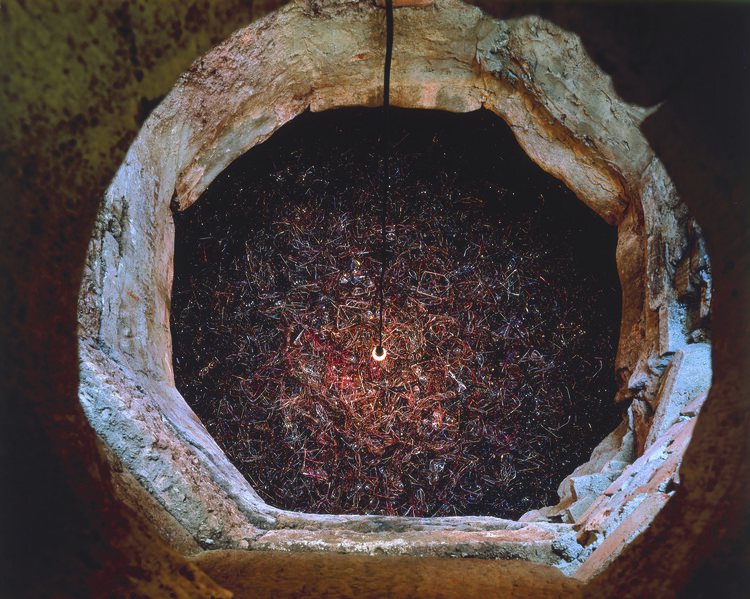
For this project, Kounellis chose the well—an essential component of the ancient city and an emblem of the archaic social order upon which every principle of civilization is founded. Emerging from the well is an enormous mass of eyeglasses—the instruments of sight that modern civilization has adopted to see better, to understand things in greater detail, and to measure the world and its objects—which in turn symbolize a form of knowledge that is equally sophisticated and distinct from any other form of naive or primitive knowledge.
Yet at the same time, it is a fragile instrument, a sign of vulnerability in the face of any savage state or attitude. So far, this is the construction, the poetic elaboration of the phrase. But the work is not exhausted by the act of its construction; it opens up to questions that it itself raises and leaves unanswered. To which of the numerous, sometimes tragic, narratives that mark the course of our history might we associate this image? What form of judgment does the work imply? What outcome does it suggest? We peer into the well to see the instruments for seeing, a mass that sinks and rises.”
Pier Luigi Tazzi, *Arte all’Arte VI*, 2001
Interview by Pier Luigi Tazzi
What is the meaning behind this work, which is quite unique both within your body of work and within the context of this year’s Arte all’Arte project?
I began with those works from late 1967 through 1968 in which I had used piles of coal. It was a tragic, collective idea. Here, I continue that tradition. Here lies the depth. The relationship between the work and the viewer has become very evident here, perhaps because the artist’s situation has changed. The well highlights a new condition that imposes verticality.
So, verticality versus horizontality. A well represents both a vertical descent and an ascent to the surface.
It’s a unique view from top to bottom. It’s like a scene. There’s this hole: it’s the deepest form of motherhood, but it’s also hellish.
Amid the Tuscan landscape—which presents itself as both a mythical paradise and the cradle of Western culture—you scratch the surface and delve to the depths.
The well is a typical feature of the Tuscan landscape. What I convey is the idea of depth, not that of the surface, and at the same time the idea of twilight, of the inevitable power of chiaroscuro.
What about the glasses?
Glasses are connected to the eyes and to vision.
In this work of yours, strength and weakness converge: the depth, the verticality, and the powerful structure of the well suggest strength, while the material filling it suggests, in a way, weakness—or at least fragility.
These two conditions together form a single one. And in this new condition, the material is not separated from the well. And we have a disruptive situation. First of all, the relationship between the various compositional elements is disrupted; everything unfolds on the surface—as far as I’m concerned, as a painter—but it is a profound surface. It’s like seeing Pollock’s canvases from Pollock’s perspective: from above. This is what allowed me to occupy the well. It marks a turning point. I realized that tonal civilization—and the bourgeoisie that sustained it—had come to an end. After two world wars, it’s ridiculous to think in terms of tonality. There is no critical relationship between the icon on the easel and the artist. The artist is a disruptive dancer moving across a vast territory. The Europe I experienced was postwar Europe, and I lived it as a dancer, moving here and there, driven by whatever drew me in. I realized that the world of before was over and had no chance of returning. Compositional centrality was over, and so it was a matter of experiencing a form of painting that was, to say the least, completely new.
Today, the urgency of art has resurfaced—this art that, for so many years, I won’t say has been reduced to the pure and simple level of production for the market, but has been dominated by the market. The spread of art has been driven by the expansion of the market, and in particular by that specific type of market: the Western market. Even if artists did not appear to be directly subservient to this principle, within the dominant culture the association between art and the market was immediate. Today we are witnessing an expansion that is fostering a dialogue between different cultures—something that was impossible just ten years ago. Cloaked in exoticism, art—as understood by Western tradition—had little to offer in terms of dialogue with those cultures. The developments of the past decade—including those directly initiated by artists, even those from different cultures and with different backgrounds—have established a whole series of ongoing, global relationships in which art has taken on a central role, not in and of itself, but in relation to human culture at this stage of civilization.
We must not forget that*Les Demoielles d’Avignon*emerged from a profound reflection on what Picasso referred to as “black art.” The issue is knowing who is speaking. If everything is lumped together, we risk playing into the hands of the market. True cultural voices must emerge everywhere, voices that in turn become cultural hubs. The formless flow of people does not lead to freedom; on the contrary, it leads to hybridization, which in turn serves to foster a colonial literature that gathers all these people together but does not give them form—much less as individuals. The painters of Europe’s past, beginning with Giotto, were cultural hubs. So much so that Raphael, even in death, rests in the Pantheon alongside the kings of Italy. Although Raphael is, of course, superior to them, this is an indication of the centrality of the artist’s figure. We must follow this guidance, which is blessed. For someone who is an artist, it is also extremely advantageous. That is how it is, and there is no point in denying it. I cannot be cynical about this, which is also my own tradition. It is a necessary reminder: it is pointless to think of art as something that never pays off. Art must pay off. This is not a matter of moralizing: art has its own weight and must pay off.
Therefore, one must understand the speaker’s position, stripping it of all abstraction.
We need to know who did what, because otherwise we encourage opportunism. I am an artist; that’s where I come from; I’ve done what I’ve done—it’s all there in retrospect. I was truly born, and I want to keep in mind that one is born naturally for specific reasons, for specific encounters—encounters and reasons that are plain to see. It’s pointless to sit there and distort the truth. Whether or not there was a formalization, anyone can see it: it’s public knowledge. An artist is a transparent person, more so than others, because everything about him is visible—even his mistakes, which do exist. They’re visible, and they’re there. One must not be afraid to present oneself as one is.
This acceptance of one's own human, individual, and intellectual responsibility is one of the great achievements of European culture.
Act without losing your sense of reason. Always act for specific reasons: then you deserve to survive. Because you might not deserve it. You must justify your survival through your own clarity of thought. If that is lacking, what does strength—or lack thereof—matter? We belong to the great family of artisans, people with a straightforward vision. The painter sees the wall and wants others to see it for what he has done to it, not in a literary sense.
Art is today the only human practice and discipline that deals with happiness in a positive sense. All the others, even if they are positive, are concerned with alleviating pain, resolving contradictions, eliminating evil and injustice, and averting or mitigating inevitable losses—but they always operate in the presence of this negativity.
The hero is of Dionysian origin: he is not Apollonian, as he seems to be. Joy is his driving force, his impulse. The painter has always had this mad attraction to happiness. An attraction all the more mad because it is without reason. His entire body of work is a mad race toward happiness.
Art at Art VI, 2001