“The plastic bag is a popular item that belongs to everyone, it crosses borders, it’s something universal in its usefulness and its uselessness.”
— Pascale Marthine Tayou Interview with Jérôme Sans and Pier Luigi Tazzi, Art to Art, 2001

“The plastic bag is a popular item that belongs to everyone, it crosses borders, it’s something universal in its usefulness and its uselessness.”
— Pascale Marthine Tayou Interview with Jérôme Sans and Pier Luigi Tazzi, Art to Art, 2001
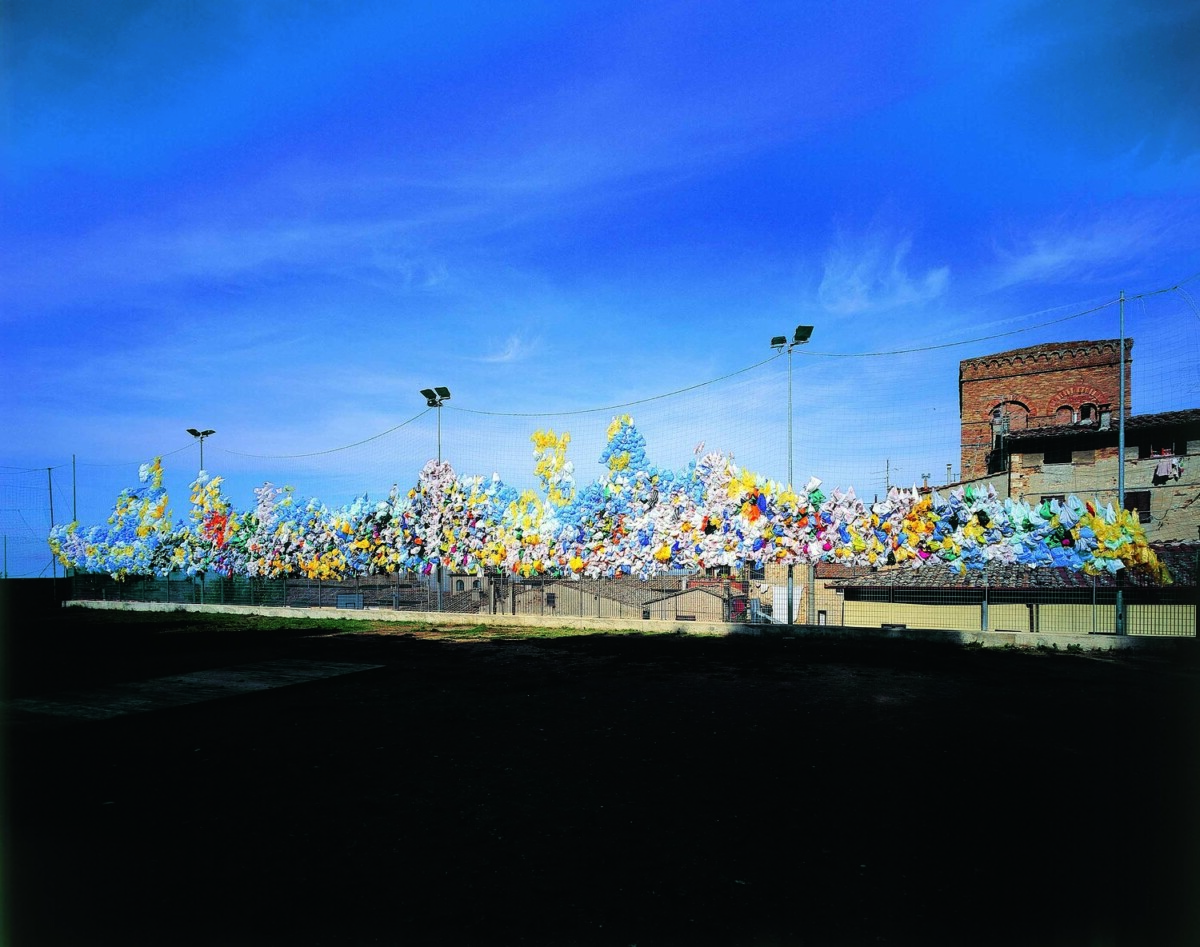
Invited by Jérôme Sans for the 6th edition of Arte all'Arte, artist Pascale Marthine Tayou chose the football field of San Gimignano as the space for his work.
"Pascale Marthine Tayou chose the football field of San Gimignano for his installation, a public and symbolic place for the social life of the town. On the net that marks the boundaries of the space, thousands of plastic bags, collected by the artist during his various travels around the world, are lightly fixed between the meshes. A simple gesture that belongs to everyone. Playing on the effect of quantity and infinitely multiplying the same action, it provokes an act of involuntary publicity. It is also an opportunity to talk about travel, about nomadism, leaving a trace of the countries visited, a sign.
Un immenso quadro volante che ondeggia al vento, installazione effimera da rinnovare all’infinito, non appartiene già più all’artista e può nutrirsi di molteplici contributi.”
Jérôme Sans, Arte all’Arte VI, 2001
Interview by Jérôme Sans and Pier Luigi Tazzi
How did your Plastic Bags project come about in the context of the Tuscan landscape?
It comes from the desire to find myself in a place in harmony with me. The other side of the city, like the vision of Tuscany, a tourist vision, an environment that is experienced like Disneyland, which on the other hand is a world of plastic, superficial. In such an environment, I’m interested in the playful side, and in Tuscany, perhaps it is the life of the people who live here, not that of the foreigners. It is its inhabitants who are foreigners like me. This city that seems open is actually a prison, and the citizens are hostages of their own environment. At first, I thought Arte all’Arte wanted to present the image of an even more beautiful Tuscany and that I had been invited to support the region's tourism policy, which I wasn’t interested in at all. On the contrary, it seemed important to me to know if there were still people living here and to offer them my plastic bags game.
How did you come to the plastic bags?
Il sacchetto di plastica è un elemento popolare che appartiene a tutto il mondo, attraversa le frontiere, è qualcosa di universale nella sua utilità e nella sua inutilità. La funzione al tempo stesso borghese e proletaria del sacchetto mi interessa perché è paradossale. Nella sua funzione borghese il sacchetto è utile per ciò che contiene, me ne infischio del valore del contenuto. Voglio andare oltre questa funzione utilitaria per immaginare un’altra storia. Si è così abituati a vederseli proporre a ogni acquisto che quando un venditore non lo fa ci sente disarmati, persi, nudi. È questa impressione banale che mi interessa. Prendo questo momento di smarrimento e lo sviluppo nell’arte plastica. L’aspetto proletario del sacchetto interviene una volta che lo si è svuotato dal suo contenuto. Povero, non serve più a niente, è servito al suo scopo, in attesa di un altro momento, un momento borghese. È solo un oggetto in permanente transito, in movimento verso altre destinazioni. È l’inutilità, il contenuto del niente, il niente al servizio del pieno.
So, you’re talking about emptiness?
No, because the moments of abandonment, of losing speed, are what’s interesting. The plastic bag then becomes an important actor, a kind of superstar, because it comes to question both ends of this weariness, this emptiness around power. It’s a great definition of my personality: I am a plastic bag, both full and empty at the same time. Maybe there will be some who, in front of this work, will say that they are just plastic bags. The audience will be able to attach their own bags and enlarge this huge fresco throughout the duration of the event. But that doesn't make it an interactive work, rather an unlimited project.
Questo muro di sacchetti di plastica crea un paesaggio “inecologico”, che vibra e gioca con il vento.
C’è una certa ironia. Si produce uno choc dal contrasto tra il paesaggio di sacchetti e quello toscano a cui si giustappone. Non sono contro l’ecologia, al contrario. Mi piace la plastica e ho voluto semplicemente affrontarla come esperienza: all’inizio non avevo idea della musicalità che produce con il vento. Anche se quest’opera comprende migliaia di sacchetti, ne sarebbe bastato uno solo. Per tornare alla questione dell’ambiente, non intendo sviluppare una proposta teorica, preferisco restare ‘leggero’ e spingere il pubblico a riflettere da solo per trovare la sua personale chiave di lettura. Questo progetto va al di là delle mie attese. Ed è questa diversità che mi interessa. La densità del lavoro stesso sparirebbe se tentassi di confrontarmi a essa, alla leggerezza del progetto. Sacchetti di plastica a parte, non si tratta di spiegare le cose, ma di farle.
You chose the verticality of the landscape, of the playing field. Why?
In Camerun, quando cala la notte, i guardiani dei supermercati segnano il confine del territorio con un filo sul quale sono attaccati dei sacchetti di plastica. Segnalano un divieto di accesso, una specie di “attenti al cane”.
Is this the first time you’ve used this material?
Ho usato a volte sacchetti di plastica, sia nelle performance che nelle installazioni, ma allora mi interessava l’effetto visivo. Oggi con questo lavoro è diventato un soggetto di conversazione, l’ho guardato un po’ più da vicino. Fa parte del mio ambiente, un oggetto che potrei difendere, proporre, sviluppare. A forza di usarlo ho trovato un’altra fonte di ispirazione, un altro gioco.
Quest’opera parla anche della fluidità inerente ai sacchetti di plastica.
The bag is a flexible, soft object. It is a perfect athlete: it jumps, swims, flies. It’s a "no bags land". A large number of the bags used in San Gimignano come from my personal collection, which has grown over time through my travels around the world. I had never thought of using them for artistic purposes. It’s a twist of fate that they end up in a parish space in Tuscany.
È l’aspetto sportivo dei sacchetti che ti ha spinto a scegliere un campo da calcio per questo lavoro?
È il mio personale lato sportivo, il mio gusto per il gioco che mi ha spinto naturalmente a questa scelta… I sacchetti non mi dominano. Cerco semplicemente di raccontare una storia, di trascrivere il mio racconto partendo da una realtà: il sacchetto.
Art at Art VI, 2001
Credits
Pascale Marthine Tayou
Plastic bags, 2001, San Gimignano, Art to Art 2001
Attilio Maranzano Photograph
© Associazione Arte Continua