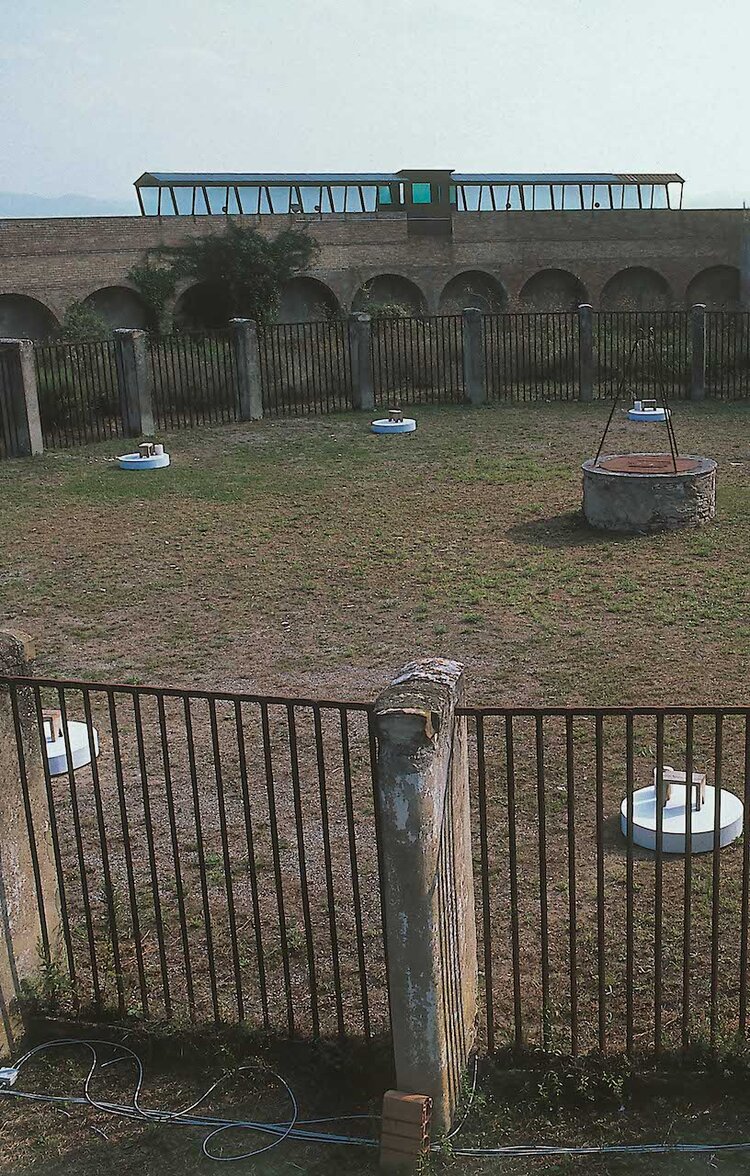
On the occasion of the VI edition of Art to Art, the curator Emanuela de Cecco He/She called to participate Mirosław Bałka nel cortile dell’ex San Domenico prison in San Gimignano.
"The work of Miroslaw Balka (Otwock, Poland, 1958) originates, like all of the Polish artist’s works, from a deep relationship with the connotations of the place that hosts it. If the walls of the courtyard of the former San Domenico prison in San Gimignano could speak, they would tell stories of every kind—the compressed desires, the anxieties, the daily thoughts of the inmates who, over the centuries, spent their outdoor hours there, all the same, for years.
With 12 x (ø 100 x 44) / time servants, the artist on one hand evokes the presence of the inhabitants who, confined to this place, experienced a time in which days, months, and years were marked by indifferent repetition—where the ghosts of the past and the future inevitably became their most faithful companions. On the other hand, he stages a broader discourse that transcends the relationship with the place and its historical connotations, transforming into a poetic reflection on the passage of time and the existential dimension implicit within it.
Il lavoro di Balka si compone di 12 sedute realizzate con legno usato e posizionate su altrettante basi circolari che si muovono lentamente su se stesse attorno al pozzo centrale preesistente. Accanto a ogni seduta, non esattamente confortevole, è disposto un vaso in alabastro, bianco come la base e contenente una pianta di ortica. Il silenzio del luogo è rotto dal sottofondo ipnotico prodotto dalla caduta dell’acqua della doccia riattivata dall’artista. Il pubblico è implicitamente invitato a sedersi sulle sedie e a lasciarsi andare al ritmo lento della rotazione: chiunque si avvicina è la presenza mancante, pronta a essere accolta sulla seduta vuota.
Sottolineando il vuoto prodotto dall’assenza, l’artista mette l’accento sulla percezione del tempo soggettiva. Ecco dunque che essere liberi o reclusi non riguarda unicamente la condizione esplicita vissuta dai carcerati, ma assume una connotazione con la quale ogni essere umano si trova quotidianamente a fare i conti e che, per esempio, emerge in tutta la sua evidenza ogni volta che, di fronte a una scelta, entriamo in un confronto, spesso doloroso, con le mura che noi stessi costruiamo dall’interno.
L’attitudine a rielaborare le memorie personali, il rapporto col corpo, l’attenzione alle relazioni tra l’opera e lo spazio che la contiene, sono elementi centrali nel lavoro dell’artista sin dagli esordi. (…)”
Emanuela de Cecco, Arte all’Arte VII, 2002